Transmission Jack Buying Guide 2026: Telescoping vs Low Profile
Telescoping or low profile? Match saddle tilt, lift range and capacity to your pan size and garage ceiling with our 2026 transmission jack buying guide.
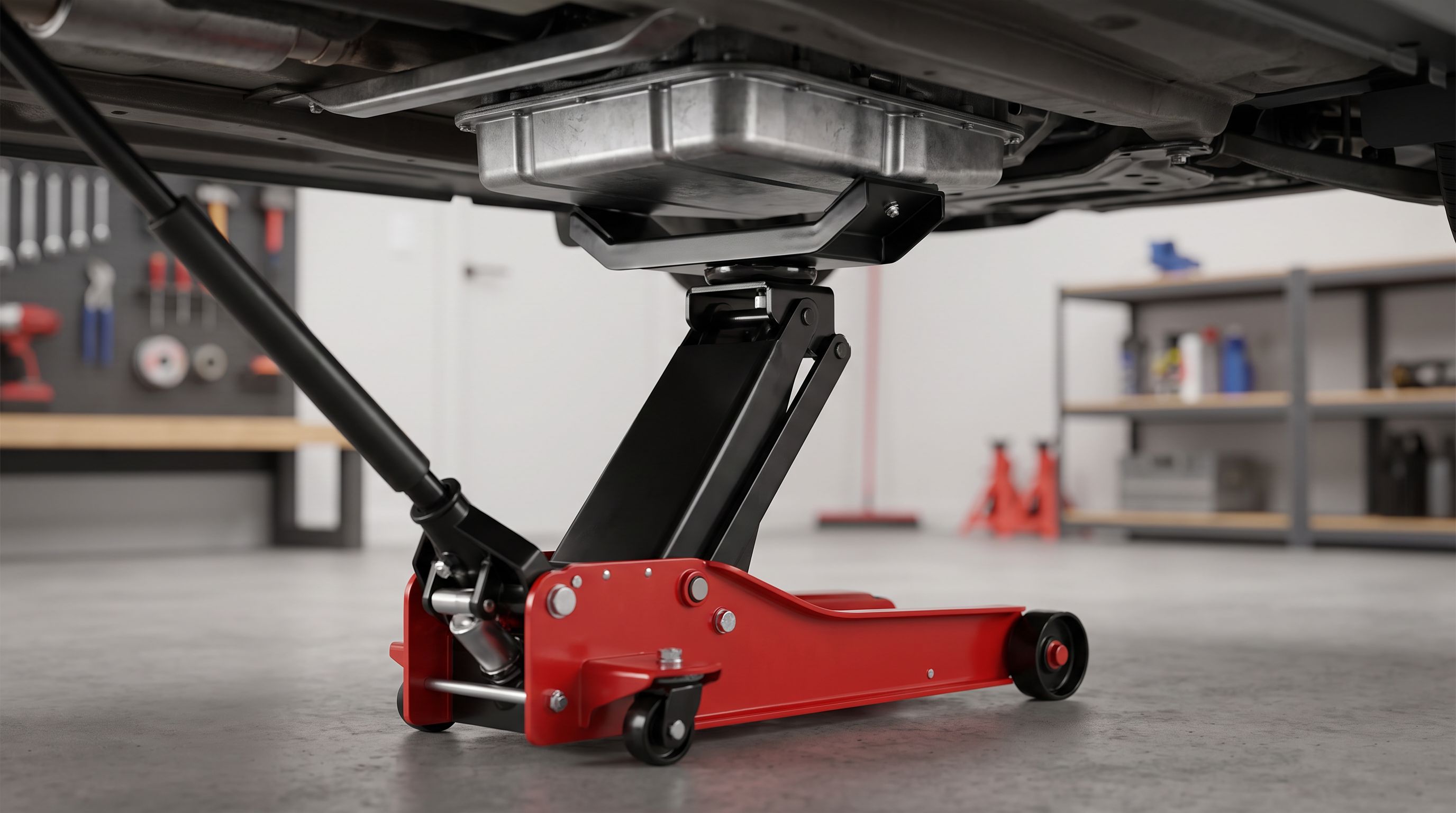
Reader-supported: we may earn a commission from links on this page, at no extra cost to you. It never affects our picks. Learn more.
Buying a transmission jack on tonnage alone is the fastest way to end up with a tool that physically cannot do the job in your garage. A 1,000 lb jack that needs 11 feet of ceiling is useless if you're working on jack stands under an 8-foot garage. A low-profile roll-under jack is equally useless if you're on a two-post lift and need to reach 67 inches overhead.
The real decision is geometry: how low the saddle starts, how high it finishes, how far it tilts in each axis, and whether the saddle actually cradles your pan. Capacity matters — but almost every DIY-relevant transmission weighs less than the cheapest jack's rating. Here's how to choose, and which units are worth your money in 2026.
The short version
- Best overall: BIG RED TR4053 Torin 1/2 Ton Telescoping Transmission Jack
- Best low profile: BIG RED TR4076 Torin Roll-Under Hydraulic Transmission Jack
- Best for jack-stand height work: JEGS 79012 Low Profile Transmission Floor Jack
- Premium pick: Sunex 7793B 1000 lb Telescopic Transmission Jack
- Budget pick: Torin T30456 Hydraulic Trolley Floor Jack Transmission Adapter
 Premium pick · Sunex 7793B 1000 lb Telescopic Transmission Jack — Check price on Amazon →
GarageProof researches and compares tools using manufacturer specifications, independent reviews and verified owner feedback. We don't physically test units — where we cite performance, it comes from published specs and documented owner experience.
Telescoping vs low profile: the core split
Transmission jacks come in two fundamentally different shapes, and they are not interchangeable.
Telescoping (pole-style) jacks stand upright on a tripod or four-leg base with a multi-stage hydraulic ram. They're designed to be rolled under a vehicle that's already in the air on a two-post or four-post lift. Typical lift ranges run from roughly 33 inches up to 67 inches or more. They're tall, relatively narrow, and they reach.
Low-profile (roll-under / floor-style) jacks look like a flattened floor jack with a saddle instead of a lift pad. They start low — often under 10 inches — and lift to maybe 30 to 36 inches. They're made for working on jack stands or a low-rise lift. Wide base, low center of gravity, far more stable when a 200 lb transmission is swinging at the end of a slow-roll move.
The mistake DIYers make is buying telescoping because the spec sheet looks more impressive. If your car is on stands at 18 inches of clearance, a telescoping jack with a 33-inch minimum height will not fit under the vehicle at all. Measure first.
How to choose
1. Start with your actual working height, not the jack's max
Get a tape measure under the car before you shop. Two numbers matter:
- Clearance height: the distance from floor to the lowest point of the vehicle when it's supported the way you plan to work.
- Drop distance: how far the transmission must travel down to clear the bellhousing dowels, crossmember and exhaust.
Your jack's collapsed height must be lower than your clearance height, with the saddle removed from the equation — some saddles add 2 to 4 inches. Your jack's maximum height must exceed clearance height plus a margin so you can actually press the pan against the engine during reinstall. On a two-post lift, you also need to confirm the jack's extended height plus the transmission's height doesn't exceed your ceiling.
If you work on jack stands, you want low profile. If you own a lift, telescoping. If you do both, buy for the harder case — usually low profile with the tallest lift range you can find in that style.
2. Match the saddle to the pan, not the spec sheet
This is the factor almost nobody checks. A transmission oil pan is stamped sheet metal; it's thin, it's often shaped like a shallow bowl, and it will dent if you put a point load on it. A good saddle spreads the load across the pan rails or the case itself.
Look for:
- Four independently adjustable corner posts or a bolt pattern so you can set the cradle to your specific pan footprint.
- Tilt in two axes — most transmissions sit nose-down a few degrees in the chassis, and you need to replicate that angle to slide the input shaft into the clutch or torque converter hub.
- Chain or strap tie-downs. Non-negotiable. A transmission is top-heavy and will walk off an untethered saddle.
If the saddle doesn't fit your pan, you can usually fabricate a hardwood spacer or steel plate to bridge it. But a saddle with real adjustability saves that whole exercise.
3. Capacity: more honest than you think, and less important
Most light-vehicle transmissions fall between 100 and 250 lbs dry. A cast-iron truck automatic with a transfer case attached can push past 350 lbs. The commonly available 1/2-ton (1,000 lb) and 1,100 lb jacks have enormous headroom for that.
Where capacity does matter is stability under eccentric load. A jack rated at 1,000 lbs is built with a heavier ram, thicker base tubing and better casters than one rated at 500 lbs — and that structure is what keeps things from tipping, not the number itself. For diesel truck work, transfer case drops, or anything with a 4WD tailshaft hanging off the back, step up a tier. Heavier-duty shop units like the OTC 1522A run 2,000 lbs, and dedicated powertrain jacks reach 3,000 lbs, but those are commercial tools at commercial prices.
4. Hydraulics, pedal vs handle, and the fine-control question
The scariest moment of any transmission job is the last inch of alignment. You want to raise and lower in small, controlled increments.
Foot-pedal pumps free both hands to steady the transmission — genuinely valuable when you're solo. Hand-lever pumps give finer feel but occupy a hand. Two-stage rams on telescoping jacks lift fast under light load then switch to a slower, higher-force stage; that's convenient, but the transition can feel abrupt.
Release valve quality separates good jacks from frustrating ones. A screw-type release that lets you crack it a quarter turn for slow descent is far better than an on/off valve that drops the load. Owner reviews are the best signal here — look specifically for complaints about "drops too fast" or "won't hold position."
5. Casters, base width and floor quality
A transmission jack is only as stable as the surface under it. Swivel casters on all corners make positioning easy but allow drift; some designs use two fixed and two swivel for better tracking. Larger-diameter casters roll over expansion joints and extension cords instead of stopping dead and tipping the load.
If your garage floor slopes toward the door — most do — plan to chock the jack or work with the drivetrain's weight biased uphill.
Comparison table
| Model | Style | Capacity (rated) | Best working height | Saddle adjustment | Best for |
|---|---|---|---|---|---|
| BIG RED TR4053 Torin | Telescoping, two-stage | 1/2 ton (1,000 lb) | Lift-height work | Tilting saddle, corner posts | Two-post / four-post lift owners |
| BIG RED TR4076 Torin | Low profile roll-under | 1/2 ton class | Jack stands, low-rise lift | Tilting, strap tie-down | Driveway and stand work |
| JEGS 79012 | Low profile floor style | 1/2 ton class | Jack stands | Four-corner adjustable saddle | Odd pan shapes, car work |
| Sunex 7793B | Telescoping | 1,000 lb | Lift-height work | Precision tilt screws | Frequent/repeat heavy use |
| Floor jack transmission adapter | Saddle adapter | Limited by host jack | Matches your floor jack | Basic tilt/cradle | One-off jobs, tight budgets |
Capacities and heights listed are per manufacturer specification; verify current figures on the product page before buying, as manufacturers revise models.
The picks
BIG RED TR4053 — best overall
Prices last checked November 6, 2026. Amazon prices change frequently, so treat these as a guide and check the live price before you buy.
BIG RED TR4053 Torin 1/2 Ton Telescoping Transmission Jack
Two-stage telescoping ram, tilting saddle and a tall lift range that suits most two-post lift work.
The TR4053 is the default recommendation for anyone lifting a vehicle on a two-post or four-post lift. Its two-stage telescoping ram covers the tall reach you need when the car is at working height, and the tilting saddle with adjustable corner posts handles most car and light-truck pans. The 1/2-ton rating is far beyond what a typical automatic or manual transmission demands, which means the structure is working well within itself.
What it gives up: it is not a jack-stand tool. The collapsed height is too tall to slide under a car supported at typical stand height, and the relatively narrow tripod base demands a flat, clean floor. Chain the load down every time.
BIG RED TR4076 — best low profile
BIG RED TR4076 Torin Roll-Under Hydraulic Transmission Jack
Low-slung roll-under design built for jack stands and shallow clearance, with a wide stable base.
If your "lift" is four jack stands on a concrete driveway, the TR4076 roll-under design is the shape you actually need. It sits low, puts its mass near the floor, and rolls under a vehicle that's only moderately raised. The wide footprint is the real selling point — a top-heavy transmission on a low, wide base is dramatically less nervous than the same load on a tall pole jack.
The trade-off is reach. You won't be using this under a vehicle at full two-post lift height; it simply doesn't extend that far. It's also heavier to reposition by hand than a pole-style jack, which cuts both ways.
JEGS 79012 — best for jack-stand height work
JEGS 79012 Low Profile Transmission Floor Jack
Starts low enough to slide under a car on stands, with a four-corner adjustable saddle.
The JEGS 79012's advantage is the saddle. Four individually adjustable corner posts let you set the cradle to an awkward pan footprint — useful on transverse front-drive transaxles, aftermarket deep pans, and anything where a fixed cradle would load the stamped pan instead of the rails. Combined with a genuinely low collapsed height, it's a sensible choice for car-focused DIYers working on stands.
What you give up: like all low-profile jacks, limited maximum height, and the saddle adjustment takes a few minutes of setup each time you change vehicles. It's also a car tool more than a heavy truck tool — for a cast-iron truck automatic with a transfer case, step up in capacity.
Sunex 7793B — premium pick
Sunex 7793B 1000 lb Telescopic Transmission Jack
Shop-grade build, 1,000 lb capacity and precise saddle tilt controls for repeat heavy use.
Sunex builds for professional shops, and the 7793B reflects it: 1,000 lb capacity in a telescopic format with notably better saddle tilt control than budget units. If you're doing transmission work more than once or twice a year — a side business, a restoration shop, a serious project garage — the finer hydraulic control and more durable build justify the step up. Reddit mechanics repeatedly report budget trans jacks lasting roughly a year under shop duty; this is the class of tool that solves that.
What it gives up: price, mainly, and it carries the same telescoping-style limitations — you need a lift to use it properly, and it's overkill for one transmission swap.
Transmission jack adapter — budget pick
If you already own a solid hydraulic trolley floor jack and you're facing a single job, a bolt-on or strap-on transmission saddle adapter converts it into a workable pan cradle for a fraction of the cost of a dedicated jack. For a one-time clutch replacement on a car you're keeping, it's a defensible choice.
Be realistic about what you lose: no fine tilt adjustment in two axes, no purpose-built tie-down geometry, and a floor jack's saddle pivot was never designed for an off-center 200 lb load. Work slowly, strap the transmission down, and never put any part of yourself under it.
Safety rules that aren't optional
- Never work under a vehicle supported only by a jack. Jack stands or a rated lift, always.
- Strap or chain the transmission to the saddle before you break the last bellhousing bolt. Tailshafts make loads tip without warning.
- Lower in small increments and reposition rather than fighting a bind.
- Don't exceed the rated capacity, and remember that a transmission full of fluid plus a transfer case plus a bellhousing is heavier than the dry weight you looked up.
- Check the floor. Cracked, sloped or oily concrete turns a stable jack into an unstable one.
FAQ
Can I use a regular floor jack with a piece of wood instead? For dropping a pan or supporting an engine briefly, yes with care. For removing and reinstalling a full transmission, no — a floor jack saddle offers no tilt control and no tie-down, and alignment on reinstall is where injuries and damaged input shafts happen.
What capacity do I actually need? For nearly all passenger cars and light trucks, a 1/2-ton (1,000 lb) jack is ample. Choose higher capacity for stability and build quality rather than raw weight — and step up if you're dropping truck automatics with transfer cases attached.
Telescoping or low profile if I can only buy one? Buy for how your vehicle is supported. Jack stands or a low-rise lift means low profile. Two-post or four-post lift means telescoping. There is no single jack that does both well.
Will the saddle fit my transmission pan? Check your pan's length, width and shape against the saddle's adjustment range before buying. Many saddles adapt with a hardwood or steel spacer plate, but a model with four independently adjustable corners saves the fabrication.
Do I need a second person? Strongly recommended, especially for alignment during reinstall. A foot-pedal-pump jack makes solo work more feasible by freeing both hands, but a helper to guide the input shaft reduces the risk of damaging the clutch disc or converter hub.
How do I know a jack is safe to keep using? Look for ram seepage, a ram that creeps down under load, damaged or binding casters, and any bent base tubing. Hydraulic jacks that won't hold position should be rebuilt or retired — not nursed along.
Our picks
Torin T30456 Hydraulic Trolley Floor Jack Transmission Adapter
Bolt-on saddle adapter that turns a floor jack you already own into a usable pan cradle.
Get the best car care deals in your inbox
Join the GarageProof newsletter for hand-picked car care deals and new buying guides. No spam, unsubscribe anytime.
Related reads
Floor Jack and Jack Stand Buying Guide 2026: Match Lift to Ride Height
The best floor jack and jack stands for 2026, matched to ride height and tonnage — low-profile sedans, half-ton trucks and lifted SUVs, with stand ratings explained.
Oil Filter Wrench Fitment 2026: Cap, Cup or Claw?
Cap, cup, claw or strap? Match the right oil filter wrench to your engine's filter size and flute count in 2026 — plus five picks that actually fit.
Brake Caliper Piston Tool Kit 2026: Match the Pin Pattern
Pick a brake caliper piston tool kit that actually fits your rear calipers in 2026 — adapter coverage, pin patterns, EPB cars and build quality compared.