Trailer Hitch Locks in 2026: Coupler vs Receiver Pin
Coupler locks vs receiver pin locks vs combo sets—compared by hitch class and coupler size so you pick the right trailer hitch lock for your setup in 2026.
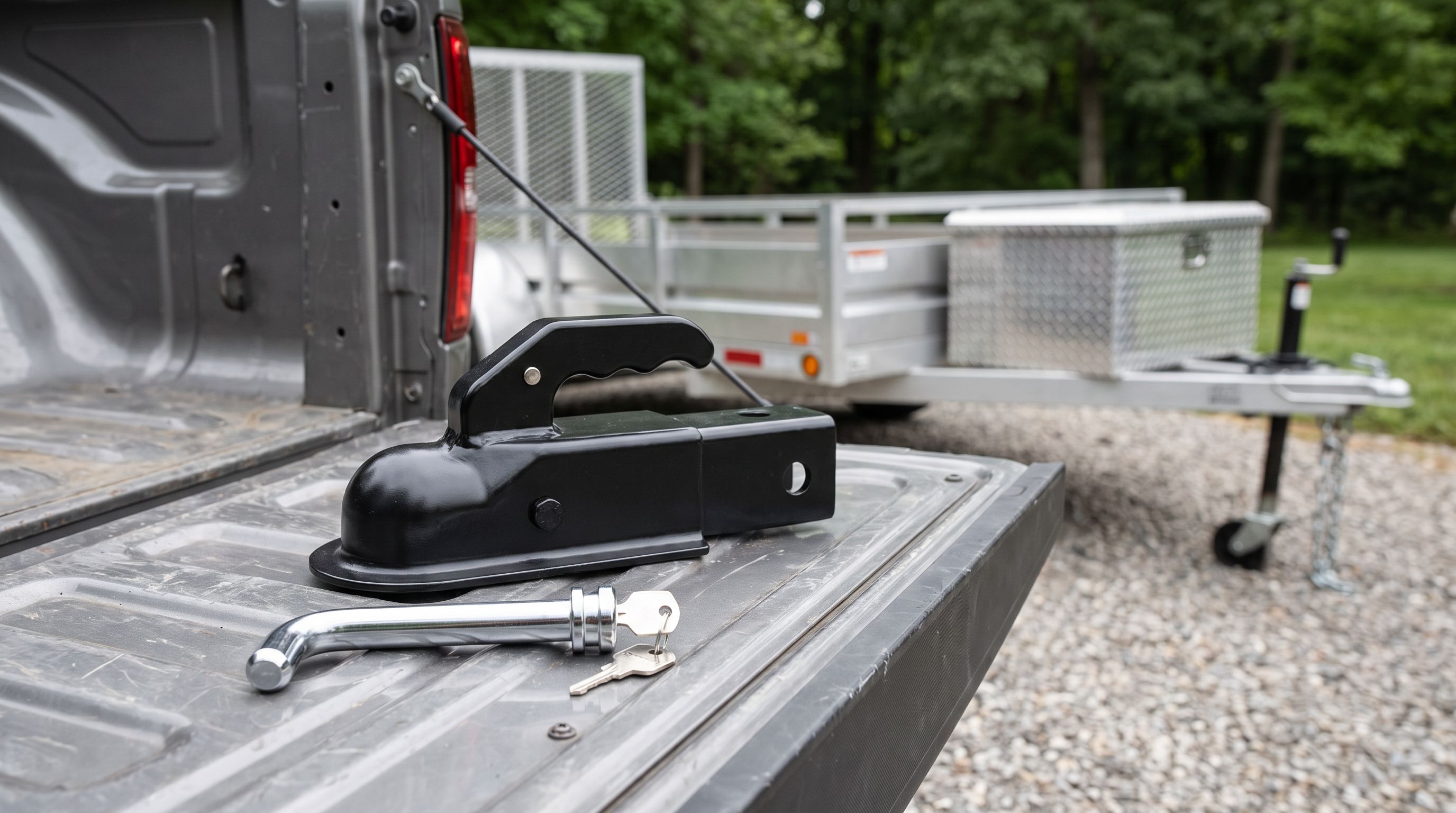
Reader-supported: we may earn a commission from links on this page, at no extra cost to you. It never affects our picks. Learn more.
The short version
- Best coupler lock: AMPLock BRP-2 Flat Lip Coupler Lock — replaces the entire latch mechanism for maximum security on flat-lip couplers.
- Best universal coupler lock: Master Lock 389DAT — fits the three most common coupler sizes without adapters, ideal for multi-trailer owners.
- Best receiver pin lock: CURT 23021 Trailer Hitch Lock — affordable, chrome-finished locking pin that keeps your ball mount from walking off.
- Best coupler + pin combo: Rhino USA Trailer Coupler Lock Kit — bundles both lock types in a single package so you're covered at either end of the hitch.
- Budget receiver pin lock: Master Lock 377DAT — a cheap, proven locking pin for anyone who just needs basic receiver protection.
 Budget receiver pin lock · Master Lock 377DAT Receiver Lock — Check price on Amazon →
 Best coupler + pin combo · Rhino USA Trailer Coupler Lock Kit — Check price on Amazon →
 Best receiver pin lock · CURT 23021 Trailer Hitch Lock — Check price on Amazon →
 Best coupler lock · AMPLock BRP-2 Flat Lip Coupler Lock — Check price on Amazon →
Why trailer hitch locks matter in 2026
A trailer sitting in a driveway or storage lot is an easy target. Most thieves don't bother picking locks; they just back up, drop the coupler over the ball, and drive away. A good trailer hitch lock adds a physical barrier that turns a 30-second crime into a loud, conspicuous hassle—often enough to send an opportunistic thief looking elsewhere.
But "trailer hitch lock" actually covers two very different products that protect two very different points:
- Coupler locks clamp over or replace the coupler on the trailer's tongue, preventing anyone from latching the coupler onto a ball.
- Receiver pin locks secure a ball mount (or other hitch accessory) inside your vehicle's receiver tube, stopping someone from sliding it out and stealing the mount, the anti-sway bar, or the entire hitch setup.
Many owners need both. Some need only one. The right answer depends on your hitch class, coupler size, and where your trailer spends its nights.
Coupler locks vs receiver pin locks vs combo sets
| Feature | Coupler lock | Receiver pin lock | Combo set |
|---|---|---|---|
| What it protects | The trailer tongue coupler | The receiver tube / ball mount | Both |
| Where it lives | On the trailer when unhitched | On the tow vehicle's receiver | Split between both |
| Sizing you must check | Coupler size (1-7/8″, 2″, 2-5/16″) and lip style (flat vs. round) | Receiver pin diameter (1/2″ or 5/8″) and receiver class | Both coupler and receiver specs |
| Primary theft it deters | Someone hooking up and towing your trailer away | Someone stealing your ball mount or hitch accessories | Both scenarios |
| Typical construction | Hardened steel clamp or replacement latch | Chrome or stainless locking pin with barrel lock | One of each, sometimes keyed alike |
| Best for | Owners who store trailers away from the tow vehicle | Owners who leave a ball mount in the receiver 24/7 | Anyone who wants full-coverage security |
A coupler lock is the higher-priority purchase if you park your trailer unattended for days or weeks. A receiver pin lock is the higher-priority purchase if you leave an expensive weight-distribution hitch or anti-sway setup in your receiver overnight. If both scenarios apply, a combo set keyed alike saves you from carrying an extra key.
How to choose
Coupler size and lip style
This is the single most common reason people buy the wrong lock. Trailer couplers come in three standard ball sizes—1-7/8″, 2″, and 2-5/16″—and two lip styles: flat lip and round lip (also called "Bulldog" or "horse-head" style). A lock designed for flat-lip 2-5/16″ couplers will not fit a round-lip 2″ coupler. Before you order, measure your coupler's ball opening and look at the latch mechanism from the side. If the coupler has a flat, stamped-steel profile, you need a flat-lip lock. If it has a rounded, cast body, look for a round-lip or universal design.
Receiver class and pin diameter
Receiver tubes are categorized by hitch class:
- Class I/II (1-1/4″ tube): uses a 1/2″ pin.
- Class III/IV/V (2″ tube): typically uses a 5/8″ pin, though some accept 1/2″.
Always measure your receiver's pin hole before buying. A 1/2″ lock will rattle in a 5/8″ hole, and a 5/8″ lock simply won't fit a 1/2″ hole.
Lock mechanism and key type
Most quality hitch locks use either a tubular (barrel) key or a standard pin-tumbler key. Tubular keys are harder to pick with common tools, but they're also harder to duplicate at a hardware store if you lose them. Look for locks that ship with at least two keys. Some brands offer keyed-alike sets so every lock in your setup opens with the same key—a genuine convenience upgrade when you're fumbling around in a dark parking lot.
Weather resistance
Trailer locks live outdoors full-time. Look for hardened steel or stainless construction, a chrome or powder-coat finish, and a dust cover over the keyhole. Locks with exposed keyholes in humid or coastal climates will corrode internally within a season. A squirt of dry graphite lubricant twice a year extends the life of any lock dramatically.
Deterrence vs. absolute security
No lock is theft-proof against a battery-powered angle grinder and five uninterrupted minutes. The goal is deterrence: making your trailer harder and louder to steal than the one parked next door. Hardened-steel bodies resist bolt cutters, bright-colored locks add visual deterrence, and anything that requires a thief to bring specific tools buys time. Pair a lock with a wheel boot or GPS tracker for the highest level of protection on expensive trailers, RVs, or boats.
Our picks
AMPLock BRP-2 — Best coupler lock
Prices last checked November 13, 2026. Amazon prices change frequently, so treat these as a guide and check the live price before you buy.
AMPLock BRP-2 Flat Lip Coupler Lock
Custom-fit, hardened-steel coupler lock that replaces the entire latch mechanism for serious theft deterrence.
The AMPLock BRP-2 takes a different approach from clamp-on coupler locks: it completely replaces the coupler latch with a hardened-steel cap that bolts into place. Because it covers the entire ball socket, there's nothing to pry or shimmy. It's designed specifically for flat-lip couplers up to 2-5/16″, so measure your coupler before ordering. Owner feedback consistently highlights the tight, rattle-free fit and the heavy-gauge steel construction. The trade-off is that installation takes a few minutes with a wrench the first time, and the lock only fits flat-lip designs—round-lip coupler owners will need to look elsewhere. Multiple reviews rank the BRP-2 among the most secure coupler locks available in 2026, and it's the lock we'd choose for a boat or RV that sits in a storage lot for weeks at a stretch.
Master Lock 389DAT — Best universal coupler lock
Master Lock 389DAT Universal Coupler Lock
Fits 1-7/8", 2", and 2-5/16" couplers without adapters—solid pick when you tow multiple trailers.
If you tow more than one trailer—say a utility trailer and a boat—the Master Lock 389DAT earns its keep by fitting 1-7/8″, 2″, and 2-5/16″ couplers without swapping adapters. It uses a ratcheting jaw mechanism that tightens around the coupler, then locks with a covered keyway. The universal design makes it more versatile than the AMPLock, but that versatility comes with a slightly less custom fit. Some owners report minor play on smaller couplers, though it's rarely enough to compromise security. The 389DAT ships with two keys and features a hardened-steel body with a chrome finish. It's a practical choice for anyone who doesn't want to buy a separate lock for every trailer in the fleet.
CURT 23021 — Best receiver pin lock
CURT 23021 Trailer Hitch Lock
Simple, affordable locking hitch pin sized for 2" receivers with a weather-resistant chrome finish.
The CURT 23021 is a straightforward locking hitch pin designed for standard 2″ receivers (Class III/IV). It replaces the basic clip-and-pin setup that comes with most hitches, adding a barrel-style lock that prevents anyone from sliding your ball mount out of the receiver. The chrome-plated steel body holds up well in weather, and the included dust cap keeps grit out of the keyhole. It won't stop someone from stealing your trailer (that's the coupler lock's job), but it does protect the ball mount, weight-distribution bars, or bike rack you've got plugged into the receiver. At its price point, the CURT 23021 is the easiest security upgrade you can make to a tow vehicle.
Rhino USA Coupler Lock Kit — Best coupler + pin combo
Rhino USA Trailer Coupler Lock Kit
Includes a coupler lock and a locking hitch pin in one box—covers both theft scenarios at a fair price.
The Rhino USA Trailer Coupler Lock Kit bundles a coupler lock and a locking receiver pin in one package, covering both the trailer tongue and the tow vehicle's receiver. The coupler lock fits 2″ couplers (check your size before buying), and the receiver pin fits standard 1/2″ pin holes. The heavy-duty steel construction and anti-corrosion coating get good marks in owner reviews. The main limitation is coupler size: if you run a 2-5/16″ coupler, this kit's coupler lock won't fit. But for owners of mid-size utility trailers, boat trailers, or small campers with 2″ couplers, the combo approach saves money and keeps your security setup simple. Both locks use separate keys, so you won't get the keyed-alike convenience of some pricier sets.
Master Lock 377DAT — Budget receiver pin lock
Master Lock 377DAT Receiver Lock
Proven, no-frills locking pin for 1/2" receiver holes—cheap insurance against hitch accessory theft.
The Master Lock 377DAT is about as simple as hitch security gets: a 1/2″ locking pin with a chrome-plated steel body and a standard pin-tumbler lock. It fits Class I through III receivers with 1/2″ pin holes. There's nothing fancy here—no dust cover, no keyed-alike option—but it does the one thing it's supposed to do: keep your ball mount from being pulled out of the receiver. At its low price, it's cheap insurance for anyone who leaves a hitch setup in the receiver overnight or at a trailhead. Just give the keyhole an occasional shot of dry lubricant to prevent seizing, especially in wet climates.
Quick-reference: matching locks to your setup
| Your setup | Coupler size | Receiver class | Recommended lock(s) |
|---|---|---|---|
| Utility trailer, flat-lip coupler, Class III truck | 2″ or 2-5/16″ | 2″ receiver (5/8″ pin) | AMPLock BRP-2 + CURT 23021 |
| Boat trailer, universal coupler, Class III truck | Varies | 2″ receiver | Master Lock 389DAT + CURT 23021 |
| Small camper, 2″ coupler, mid-size SUV | 2″ | 2″ receiver (1/2″ pin) | Rhino USA Coupler Lock Kit |
| Light cargo trailer, Class I/II vehicle | 1-7/8″ | 1-1/4″ receiver (1/2″ pin) | Master Lock 389DAT + Master Lock 377DAT |
| RV or large travel trailer, flat-lip coupler | 2-5/16″ | 2″ receiver (5/8″ pin) | AMPLock BRP-2 + CURT 23021 |
FAQ
Do I need a coupler lock, a receiver pin lock, or both?
If you store your trailer unhitched, a coupler lock is the priority—it stops someone from hooking up and driving away. If you leave a ball mount or hitch accessory in the receiver on your tow vehicle, a receiver pin lock prevents that from being stolen. For full coverage, get both.
Will a coupler lock fit any trailer?
No. You must match the lock to your coupler's ball size (1-7/8″, 2″, or 2-5/16″) and its lip style (flat or round). Universal models like the Master Lock 389DAT cover multiple sizes, but even they may not fit every non-standard coupler. Always measure first.
Can a thief still steal my trailer with a coupler lock installed?
A determined thief with power tools can defeat any lock given enough time and privacy. Coupler locks deter opportunistic theft—the most common kind. For high-value trailers, combine a coupler lock with a wheel lock or boot and a GPS tracker.
What's the difference between a 1/2″ and 5/8″ receiver pin?
The diameter of the pin that passes through the receiver tube and ball mount. Class I and II receivers (1-1/4″ tube) use 1/2″ pins. Class III, IV, and V receivers (2″ tube) typically use 5/8″ pins, though some accept 1/2″. Measure the hole in your receiver before ordering.
How do I maintain a trailer hitch lock?
Apply a dry graphite or PTFE-based lubricant to the keyhole and moving parts two to three times per year. Avoid WD-40 or oily lubricants in the lock cylinder—they attract dust and can gum up the pins over time. If you're in a coastal area, rinse salt spray off the lock body periodically and reapply lubricant afterward.
Get the best car care deals in your inbox
Join the GarageProof newsletter for hand-picked car care deals and new buying guides. No spam, unsubscribe anytime.
Related reads
Rust Converter vs Encapsulator 2026: Match It to Your Metal
Rust converter for cars, epoxy encapsulator, or chassis paint? How to match the product to how deep the corrosion goes — and what topcoat you plan to use in 2026.
Mud Flaps for Trucks 2026: Fit the Wheel Well, Not the Badge
Heavy-duty mud flaps for trucks in 2026: how wheel-well lip, lift height and flare type decide whether drill-in or no-drill kits actually fit.
Hub Centric Wheel Spacers 2026: Get the Bore Right First
Hub centric wheel spacers in 2026: how to match hub bore, bolt pattern and stud engagement to your vehicle — plus four spacer brands worth considering.