Electric Winch for Truck 2026: Sizing It by Vehicle Weight
How to size an electric winch for a truck or SUV in 2026: the 1.5x GVWR rule, synthetic vs steel line, mount plate fitment, plus four picks compared.
Reader-supported: we may earn a commission from links on this page, at no extra cost to you. It never affects our picks. Learn more.
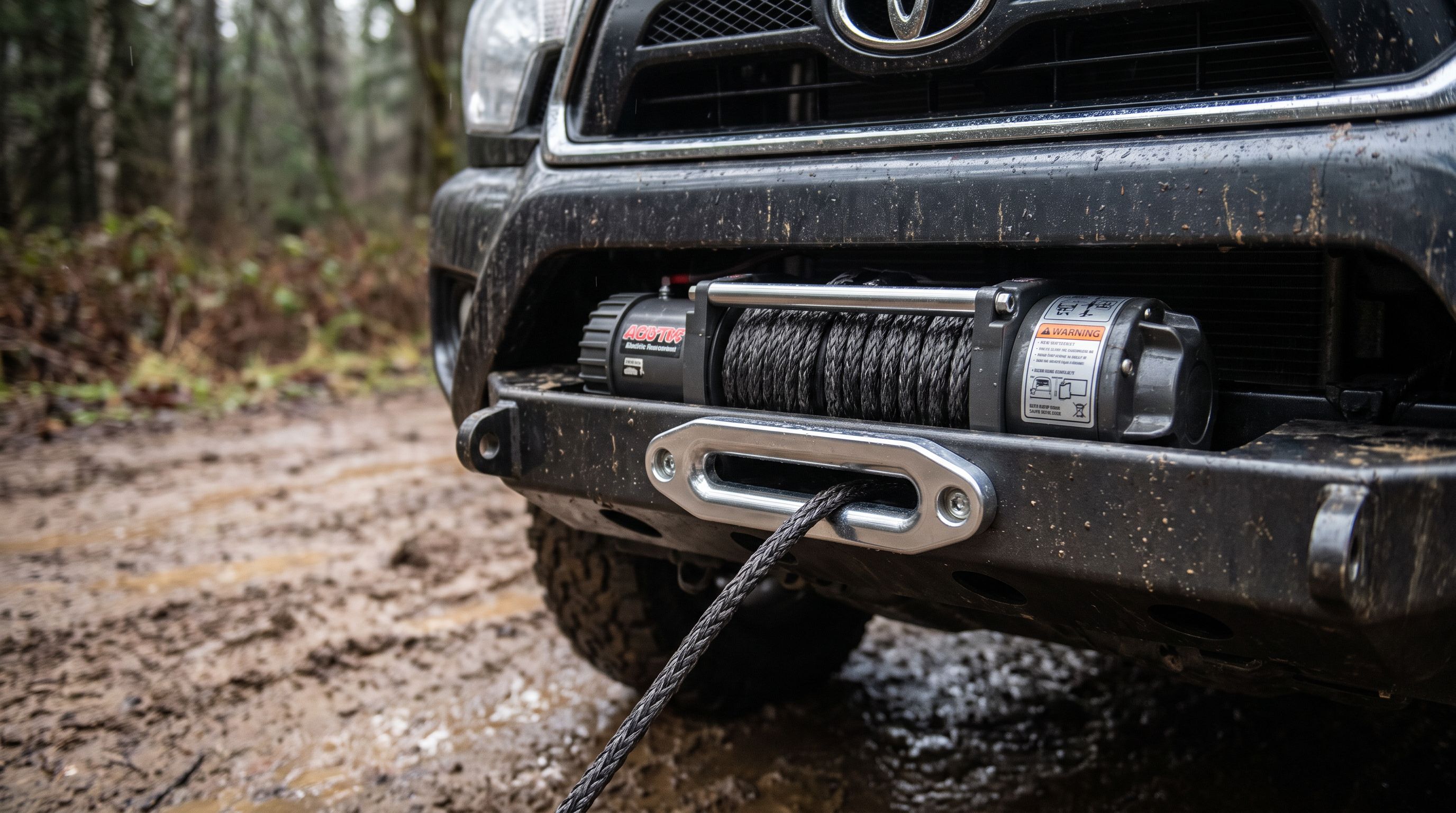
Buying a winch is one of the few truck purchases where guessing wrong has real consequences. Undersize it and the motor cooks halfway through a recovery. Oversize it and you've bolted 90 extra pounds over the front axle for nothing. Mount it to the wrong plate and it simply won't bolt in.
This guide walks through how to size an electric winch for a truck or SUV by vehicle weight, how to decide between synthetic rope and steel cable, and how to confirm the mount plate actually fits your year, make, and model. We compared current 2026 models using manufacturer specs, independent reviews, and verified owner feedback — GarageProof does not physically test winches.
The short version
- Best overall: Warn VR EVO 10 (103252)
- Best synthetic-rope pick: Warn VR EVO 10-S (103253)
- Best value for Jeeps and mid-size trucks: Smittybilt XRC GEN2 9500 (97495)
- Best budget heavy-duty: Nilight 13000 lb Electric Winch
- Premium pick: Warn ZEON 10-S
 Premium pick · Warn ZEON 10-S — Check price on Amazon →
 Best synthetic-rope pick · Warn VR EVO 10-S (103253) — Check price on Amazon →
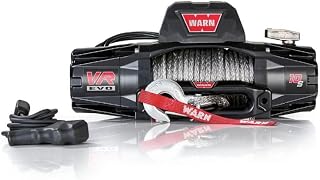 Best overall · Warn VR EVO 10 (103252) — Check price on Amazon →
Sizing: the 1.5x GVWR rule, and why it's a floor not a ceiling
The industry rule of thumb is simple: multiply your vehicle's GVWR by 1.5 and buy a winch rated at or above that number.
GVWR — gross vehicle weight rating — is on the door jamb sticker, not the brochure. It's the maximum loaded weight of the vehicle, which is the number that matters because you'll be stuck fully loaded with gear, fuel, and passengers, not empty.
Rough starting points:
- Jeep Wrangler / Bronco / mid-size truck (GVWR roughly 5,000–6,500 lb): 8,000–9,500 lb winch
- Half-ton pickup — F-150, Silverado 1500, Ram 1500 (GVWR roughly 6,800–7,600 lb): 10,000–12,000 lb winch
- Three-quarter and one-ton trucks (GVWR 9,000 lb and up): 12,000–16,500 lb winch
Why 1.5x and not 1.0x? Because the rated pull is a first-layer, single-line, bare-drum figure. Two things erode it fast:
Drum layering. Every wrap of line that stacks on the drum increases the effective radius and cuts pulling power. A 10,000 lb winch might only deliver around 7,000 lb on the second layer and closer to 5,500 lb on the fourth. If you're recovering from 60 feet away with most of the line still spooled, you're nowhere near the number on the box.
Resistance multipliers. Deep mud, a 30-degree slope, or a buried axle can demand two to three times the vehicle's static weight in pull force. The 1.5x rule buys headroom for drum layering; a snatch block buys headroom for everything else.
That's why 10,000 lb has become the default recommendation for full-size pickups and why most 2026 roundups land on the Warn VR EVO 10 as the sensible middle. Going bigger than 1.5x isn't wrong — it just adds weight and current draw, and heavier winches ask more of your charging system.
Duty cycle matters more than peak rating
Electric winches are intermittent-duty tools. Pull for 30–60 seconds, stop, let the motor cool, repeat. Budget winches and premium winches often share similar peak ratings but differ enormously in how long they can sustain a pull and how gracefully they handle heat. A sealed motor and a quality contactor are what separate a winch that survives five recoveries in an afternoon from one that gives up on the second.
Synthetic rope vs steel cable
This is the other decision that genuinely changes the ownership experience.
| Synthetic rope | Steel cable | |
|---|---|---|
| Weight | Roughly a third to half of steel | Heavy; adds noticeable nose weight |
| Failure behavior | Stores little kinetic energy; drops rather than whips | Stores energy; can whip dangerously if it snaps |
| Handling | No burrs, bare hands usually fine | Splinters and fraying — gloves mandatory |
| Abrasion resistance | Vulnerable to sharp rock and hot drums | Excellent |
| UV / chemical exposure | Degrades over time; needs inspection | Largely unaffected |
| Field repair | Can be re-spliced | Not practical |
| Fairlead required | Hawse (aluminum) | Roller |
| Best for | Trail use, winch-out recoveries, weight-conscious builds | Logging, rock drags, abrasive or high-heat work |
For most truck and SUV owners doing occasional self-recovery, synthetic wins — it's safer under load and far more pleasant to handle. If your winch lives outside year-round, gets dragged across granite, or does heavy repeated work where the drum heats up, steel still has a place.
Two practical notes: you cannot run synthetic rope through a roller fairlead without accelerating wear, and you shouldn't run steel through a hawse. Swap the fairlead with the line. Also, synthetic rope should be inspected every season for glazing, fuzzing, and cut strands — it's a consumable, and replacement rope is a normal maintenance item.
Mount plates and fitment — the part people skip
Here's the thing that trips up first-time buyers: a winch does not bolt to your bumper. It bolts to a mounting plate, and that plate is vehicle-specific.
Nearly all full-size recovery winches use a standard 10 inch x 4.5 inch four-bolt pattern. That's the good news — the winch itself is largely universal. What isn't universal is the plate or winch-ready bumper that carries it.
Your options:
- Winch-ready aftermarket bumper — cleanest result, usually the most expensive, and model-specific.
- Hidden/behind-grille mount plate — bolts to the frame behind the factory bumper. Year, make, and model specific, and often trim-specific (adaptive cruise radar, parking sensors, and tow hooks all complicate it).
- Receiver-hitch cradle — a portable mount that slides into a 2 inch receiver. Flexible (front or rear if you have a front receiver), no permanent install, but you're carrying the winch loose when it's not mounted.
Before you buy anything, measure three things: the winch footprint (length, including motor and control pack), the clearance behind your bumper, and whether the control pack is integrated or remote-mounted. Integrated packs sit on top of the winch and need vertical room; remote packs can be relocated but need a wiring path. Then check the plate manufacturer's fitment lookup for your exact year, make, model, and trim. If you have front radar, factory fog lights, or a tow package, confirm those are addressed.
How to choose
Electrical system capacity
A 10,000 lb winch under heavy load can draw 350–450 amps. That is more than your alternator produces. In practice the battery carries the surge and the alternator recharges between pulls, which is why you should keep the engine running during a recovery and why a tired battery is a bigger limitation than most people realize. If you winch frequently, a high-reserve AGM battery and upgraded grounds do more for real-world performance than jumping up a size class.
Remote type and control pack sealing
Every pick here includes a wired remote; most also include wireless. Wireless is genuinely useful because it lets you stand clear of the load path and watch the rigging. But keep the wired remote in the vehicle — wireless receivers fail, batteries die, and the corded remote is your backup. Separately, look for IP-rated or explicitly waterproof-rated solenoid packs if you ford water or live where roads are salted.
Gear train and line speed
Most recovery winches use a three-stage planetary gearset — compact, reasonably efficient, and self-braking under load. Line speed under load is the spec worth comparing between models: a faster winch gets you unstuck sooner and spends less time generating heat. Premium models like the ZEON series pull meaningfully faster under load than entry-level units with similar ratings.
The rigging you must buy alongside it
A winch alone isn't a recovery kit. Budget for a tree saver strap, at least two rated shackles (soft shackles are a good synthetic-rope companion), a snatch block or pulley to double line pull and change angles, a damper blanket to lay over the line, and heavy gloves. This gear is not optional — it's what turns the winch from a tool into a safe recovery system.
The picks
Warn VR EVO 10 — best overall
Prices last checked November 6, 2026. Amazon prices change frequently, so treat these as a guide and check the live price before you buy.
Warn VR EVO 10 (103252)
10,000 lb rated, sealed contactor, and the widest mount-plate support of any winch here.
The VR EVO 10 (part number 103252) is the default recommendation for half-ton pickups and the model most 2026 roundups converge on. It's rated at 10,000 lb, uses a three-stage planetary gear train, and ships with a sealed contactor plus both wired and wireless remotes. The practical advantage over cheaper competitors isn't the rating — it's that Warn's mount-plate and bumper ecosystem is the broadest in the industry, so finding a vehicle-specific plate for your truck is straightforward. What it gives up: it ships with steel cable and a roller fairlead, so if you want synthetic you're either buying the -S variant or converting later. Line speed is adequate rather than fast.
Warn VR EVO 10-S — best synthetic-rope pick
Warn VR EVO 10-S (103253)
Same proven VR EVO platform with Spydura synthetic rope and an aluminum hawse fairlead.
Mechanically the same platform as the 103252, the 10-S (103253) swaps in Warn's Spydura synthetic rope and an aluminum hawse fairlead. For anyone who will be handling the line by hand on trail recoveries, this is the version to buy. Synthetic drops instead of whipping if it fails, weighs far less to walk out to an anchor, and won't splinter your palms. The trade-offs are real though: synthetic is more vulnerable to abrasion over rock edges, degrades with UV exposure, and should be inspected and eventually replaced as a wear item. If your winch lives uncovered through harsh winters, factor that in.
Smittybilt XRC GEN2 9500 — best value for Jeeps and mid-size trucks
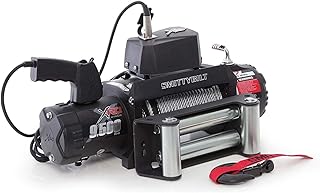
Smittybilt XRC GEN2 9500 (97495)
9,500 lb rating, waterproof-rated solenoid pack, and dual remotes at a mid-tier price.
The 97495 sits in the sweet spot for Wranglers, Broncos, Tacomas, and Colorados where 9,500 lb comfortably clears the 1.5x GVWR threshold. It uses a waterproof-rated solenoid pack, includes both wired and wireless remotes, and has a long enough track record that owner feedback on longevity is substantial rather than speculative. It's heavier than it looks and the standard steel cable adds to that. Duty cycle and line speed under load don't match the Warn units, so it's better suited to occasional self-recovery than to a day of repeated pulls. For a weekend trail rig, that's a reasonable compromise.
Nilight 13000 lb Electric Winch — best budget heavy-duty
Nilight 13000 lb Electric Winch
13,000 lb rating with wired and wireless remotes for heavy half-tons and occasional use.
If your GVWR sits above 8,000 lb — a loaded three-quarter-ton, a heavy overland build, or a truck that tows — the 1.5x math pushes you past 12,000 lb, and that class gets expensive fast. The Nilight 13000 covers the rating requirement with wired and wireless remotes at entry-level money. Be realistic about what you're accepting: shorter sustained duty cycle, less refined sealing, and a thinner support and parts network than Warn. Expect to be more disciplined about cooling pauses between pulls, and check the included cable gauge against your intended mounting distance. For an emergency tool used a handful of times a year, it's defensible.
Warn ZEON 10-S — premium pick
Warn ZEON 10-S
Faster line speed, better sealing, and an integrated control pack for frequent recovery work.
The ZEON 10-S is the upgrade for people who winch often rather than occasionally. Compared to the VR EVO line it offers higher line speed under load, better sealing against water and dust, an integrated control pack with a cleaner install, and Spydura Pro synthetic rope. It also looks far better in an exposed bumper application, which matters more to some buyers than they'll admit. The downsides are cost and packaging — the integrated control pack needs vertical clearance that some hidden-mount plates don't have. Measure before ordering, and confirm your chosen plate lists ZEON compatibility specifically.
FAQ
Do I really need 1.5x GVWR, or is that marketing? It's an engineering buffer, not marketing. Rated capacity is measured on the first layer of a bare drum. Once line stacks up, available pull drops sharply — often 30–45% by the fourth layer. The 1.5x figure keeps you in a usable range through normal spooling.
Can I use a snatch block instead of buying a bigger winch? Partly. A snatch block roughly doubles pull force at the cost of halving line speed, and it lets you redirect the pull angle. It's the single most valuable accessory you can carry. But it doesn't fix an undersized motor's duty cycle, and it needs a second anchor point — so size the winch properly and carry the block anyway.
Will any winch fit my truck? The winch itself almost certainly will — the 10 x 4.5 inch four-bolt pattern is near-universal for full-size recovery winches. The mounting plate is the vehicle-specific part. Look up a plate or winch-ready bumper by your exact year, make, model, and trim, and verify clearance for the control pack and any front radar or sensors.
How often should I service a winch? Spool the line out and back under light load a couple of times a year to check for damage and to re-lay it evenly. Inspect synthetic rope every season for fuzzing, glazing, or cut strands. Check that electrical terminals are clean and tight, and that the control pack seals haven't cracked. Rinse salt and mud off after exposure.
Front or rear mount? Front covers most situations because you usually want to pull yourself back the way you came. A receiver-cradle winch with front and rear 2 inch receivers gives you both, at the cost of mounting time and storage space. If you're choosing one permanent install, go front.
Get the best car care deals in your inbox
Join the GarageProof newsletter for hand-picked car care deals and new buying guides. No spam, unsubscribe anytime.
Related reads
Car Window Breaker Escape Tool 2026: Spring vs Hammer
Spring-loaded punches fail on laminated side glass. Compare car window breaker escape tools for 2026 and learn which windows in your car can actually be broken.
Battery Terminal Replacement 2026: Top Post vs Side Post
Battery terminal replacement in 2026: how to match top-post, side-post and GM stud fitments, size cable gauge correctly, and which clamp kits are worth buying.
Car Fire Extinguisher 2026: Which Rating Fits a Vehicle
ABC vs BC vs clean agent, UL ratings explained, EV considerations and bracket fitment — plus car fire extinguisher picks for every budget in 2026.