Dehumidifier for Your Garage in 2026: Size It Right
Find the best dehumidifier for your garage in 2026. We compare capacity, drain options, and low-temp performance so your stored vehicles and tools stay rust-free.
Reader-supported: we may earn a commission from links on this page, at no extra cost to you. It never affects our picks. Learn more.
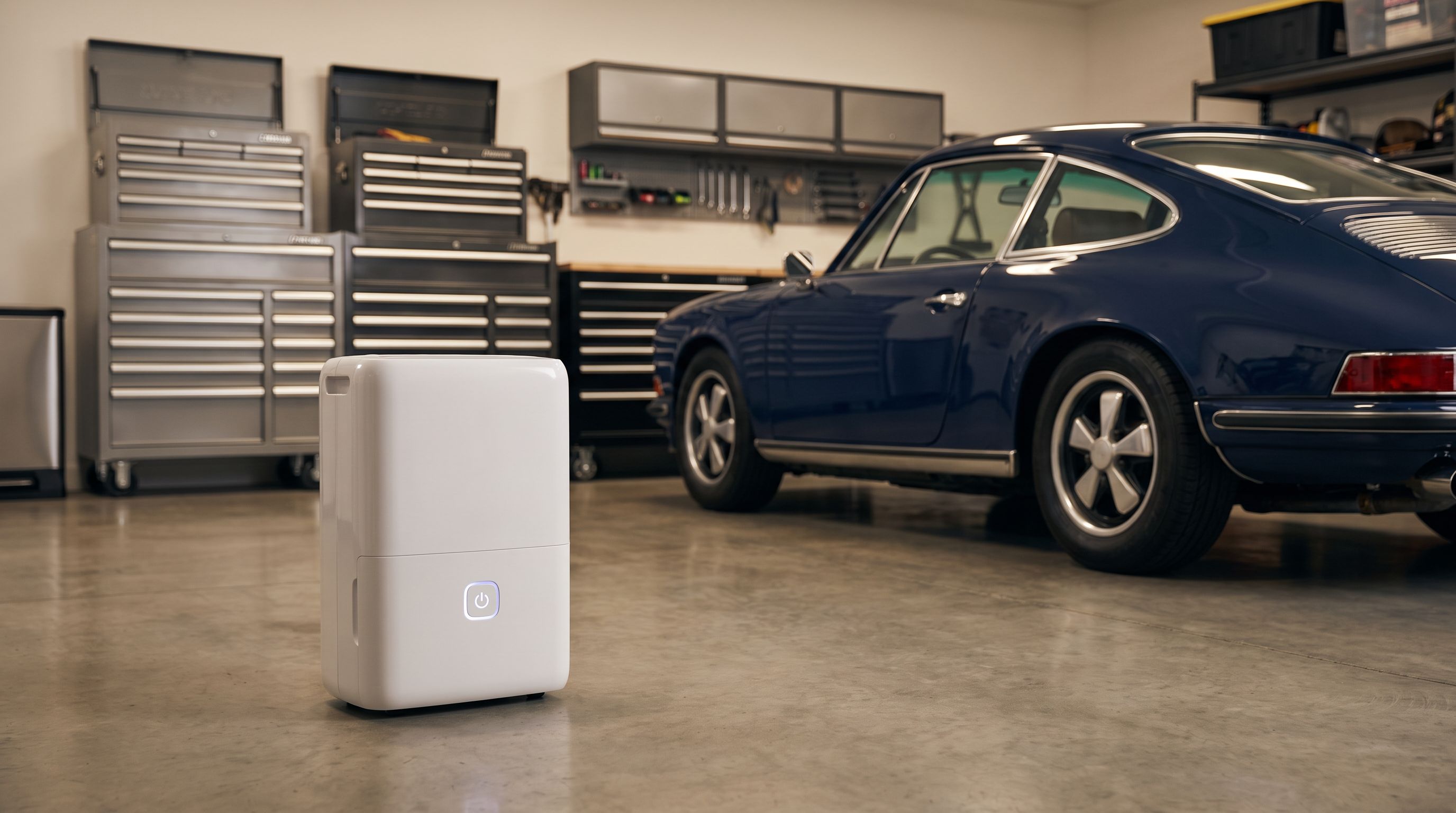
Moisture is the silent enemy of every garage. It corrodes bare metal, rusts hand tools, fogs headlights, and turns leather interiors musty—sometimes in a single humid season. A well-chosen dehumidifier keeps relative humidity below the 50 % threshold where corrosion accelerates, protecting your stored vehicles, rolling tool chests, and anything else you don't want pitting or mildew.
The trick is matching the unit to your garage's square footage, drainage situation, and operating temperature. Grab a 25-pint unit for a three-car space and it'll run 24/7 without making a dent. Buy a whole-house ducted system for a one-car bay and you've thrown money away. Below, we break down five picks that cover every common garage size and budget, then walk through the factors that actually matter.
The short version
- Best overall: Midea Cube 50-Pint Dehumidifier (MAD50S1QWT)
- Best moisture removal: Frigidaire Gallery 50-Pint Dehumidifier (FGAC5044W1)
- Best for small garages: GE 25-Pint Portable Dehumidifier (ADHR25LA)
- Best for large garages: hOmeLabs 4,500 Sq Ft Dehumidifier (HME020031N)
- Premium pick for climate-controlled shops: AprilAire E100C Whole-Home Dehumidifier
 Best for small garages · GE 25-Pint Portable Dehumidifier (ADHR25LA) — Check price on Amazon →
 Best overall · Midea Cube 50-Pint Dehumidifier (MAD50S1QWT) — Check price on Amazon →
How to choose
Capacity: match pints-per-day to square footage
The DOE rates dehumidifiers by how many pints of water they pull from the air in 24 hours at standardized conditions. As a rule of thumb:
- Up to ~500 sq ft (one-car garage): 20–25 pints/day is usually sufficient.
- 500–1,000 sq ft (two-car garage): 35–50 pints/day handles moderate to high humidity.
- 1,000–2,500 sq ft (three-car or shop bays): 50+ pints/day, or a ducted commercial unit.
If your garage is poorly sealed—think a dirt floor, no vapor barrier, or a door that doesn't close flush—size up by at least one tier. Same goes for regions with sustained 80 %+ outdoor humidity (Gulf Coast, Pacific Northwest winter, etc.).
Drain options: bucket, gravity hose, or built-in pump
Emptying a bucket twice a day gets old fast when the unit is in a detached garage you only visit on weekends. Look for these drainage tiers:
| Drain Type | How It Works | Best For |
|---|---|---|
| Bucket only | Manual emptying every few hours in humid conditions | Occasional or short-term use |
| Gravity hose | A standard garden-hose adapter drains to a floor drain or outside, but water only flows downhill | Garages with a floor drain or exterior slope |
| Built-in pump | The unit pumps water upward (typically 15–16 ft vertically) to reach a window, sink, or drain line | Basements, garages without floor drains, and unattended operation |
A built-in pump is the standout convenience feature for a garage. It lets you route a narrow drain line out a window or into a utility sink without relying on gravity—critical when the dehumidifier sits on a slab at grade level.
Operating temperature range
Most compressor-based dehumidifiers start losing efficiency below about 65 °F (18 °C), and many shut down entirely around 41 °F (5 °C) to prevent the coils from icing up. If your garage isn't insulated—or if you live somewhere with cool shoulder seasons—this matters a lot. Look for models that advertise low-temperature operation down to at least 41 °F and have an automatic defrost cycle.
Desiccant-wheel dehumidifiers work at lower temperatures than compressor units, but they're far less common in consumer sizes and tend to be less energy-efficient. For most garage owners, a compressor unit with auto-defrost is the practical choice.
Noise level
Garages amplify noise because of hard walls and concrete floors. If you spend time wrenching or woodworking while the unit runs, anything above ~50 dB will compete with a conversation. The Midea Cube, for example, has been noted in multiple independent reviews for its unusually quiet operation—a real advantage if you're in the garage for hours at a time.
Smart features and Wi-Fi
Wi-Fi connectivity lets you monitor humidity and get full-tank alerts on your phone—handy when the dehumidifier is in a detached garage you don't check daily. It's a nice-to-have, not a must, but it can prevent a full-bucket shutdown from going unnoticed for days.
Our picks
Midea Cube 50-Pint (MAD50S1QWT) — Best overall
Prices last checked November 18, 2026. Amazon prices change frequently, so treat these as a guide and check the live price before you buy.
Midea Cube 50-Pint Dehumidifier (MAD50S1QWT)
Compact cube design, built-in pump, Wi-Fi, and class-leading quiet operation for most garages.
The Midea Cube has earned top marks from Wirecutter, CNN Underscored reviewers, and numerous owner communities—including dedicated garage-use threads on Reddit—and it's easy to see why. Its unusual cube form factor is shorter and more compact than tower-style dehumidifiers, so it tucks against a garage wall without eating floor space. The built-in pump can push water up to about 16 feet vertically, which means you can route the drain line out a window or into overhead plumbing without a separate condensate pump. Wi-Fi and app control let you monitor humidity from inside the house.
The trade-off is that 50 pints per day, while ample for most two-car garages, may not keep up in a very large or very leaky three-car bay. And like all compressor units, efficiency drops in cold weather—Midea specs a 41 °F low-end operating temperature. If your unheated garage regularly drops below that in winter, you'll need supplemental heating or a desiccant solution.
Frigidaire Gallery 50-Pint (FGAC5044W1) — Best moisture removal
Frigidaire Gallery 50-Pint Dehumidifier (FGAC5044W1)
Top-tier extraction speed in independent testing—ideal for damp, high-humidity garage environments.
In independent testing reported by CNN Underscored in 2026, the Frigidaire Gallery extracted more moisture from the air in a set period than competing 50-pint models. If your garage gets seriously damp—standing condensation on the floor, visible fog when you open the door on a summer morning—that raw extraction speed matters.
The unit supports continuous gravity drain and includes a washable filter, but it lacks the built-in pump that the Midea Cube offers. That means you'll need either a floor drain, a slight slope to route water outside, or a separate condensate pump. It's also a more traditional upright shape, so it has a larger footprint than the Cube. For sheer dehumidification muscle, though, it's hard to beat.
GE 25-Pint Portable Dehumidifier (ADHR25LA) — Best for small garages
GE 25-Pint Portable Dehumidifier (ADHR25LA)
Right-sized for a single-bay garage with smart-dry controls and a slim, portable footprint.
Not every garage is a cavernous three-bay shop. If you have a single-car or small tandem garage under roughly 500 square feet, a 50-pint unit is overkill—and draws more power than you need. The GE 25-Pint Portable hits a sweet spot: its Smart Dry feature adjusts fan speed and compressor cycling based on ambient humidity, so it doesn't run full-blast when conditions are mild.
The compact footprint and lighter weight make it easy to reposition—useful if you want to move it closer to a stored vehicle during winter months. The downside is that it lacks a built-in pump, so continuous drainage depends on gravity, and 25 pints per day won't keep pace with a larger or very wet space.
hOmeLabs 4,500 Sq Ft Dehumidifier (HME020031N) — Best for large garages
hOmeLabs 4,500 Sq Ft Dehumidifier (HME020031N)
High-capacity extraction handles oversized or three-car garages without breaking a sweat.
For oversized garages, pole barns, or multi-bay workshops, the hOmeLabs high-capacity unit is purpose-built. Rated for spaces up to 4,500 square feet, it pulls enough moisture to keep a large, open shop below the corrosion danger zone even in humid climates. A continuous-drain hose connection helps with unattended operation.
Owner feedback consistently praises the value proposition: it delivers high-capacity performance at a price well below commercial units. Be aware that noise is higher than smaller models—hard surfaces in a big shop won't help—and the unit is bulky. It's not the one to choose if your space is a tidy single-car garage; it's the one to choose when nothing else keeps up.
AprilAire E100C — Premium pick for climate-controlled shops

AprilAire E100C Whole-Home Dehumidifier
Ducted, commercial-grade unit for dedicated workshop builds where humidity control is non-negotiable.
The AprilAire E100C is a different animal entirely. It's a whole-home, ducted dehumidifier designed for permanent installation—typically tied into existing HVAC ductwork. For garage owners who have invested in insulation, a mini-split, and real climate control for a restoration shop or serious woodworking space, this is the endgame.
It handles up to 100 pints per day and operates efficiently at lower temperatures than most portable units. The trade-off is cost and complexity: professional installation is essentially required, and the price tag is in a completely different league from portable dehumidifiers. It makes sense only when humidity control is mission-critical and you're already running conditioned air in the space.
Comparison table
| Feature | Midea Cube 50-Pint | Frigidaire Gallery 50-Pint | GE 25-Pint | hOmeLabs 4,500 Sq Ft | AprilAire E100C |
|---|---|---|---|---|---|
| Capacity | 50 pt/day | 50 pt/day | 25 pt/day | ~50 pt/day | Up to 100 pt/day |
| Recommended space | Up to ~1,000 sq ft | Up to ~1,000 sq ft | Up to ~500 sq ft | Up to ~4,500 sq ft | Whole-home / shop ducted |
| Built-in pump | Yes | No | No | No | N/A (ducted drain) |
| Wi-Fi / App | Yes | No | Yes (Smart Dry) | No | No (thermostat integration) |
| Gravity drain option | Yes | Yes | Yes | Yes | Ducted |
| Low-temp operation | ~41 °F min | ~41 °F min | ~41 °F min | ~41 °F min | Lower than portable units |
| Form factor | Compact cube | Upright tower | Compact upright | Large upright | Permanent mount |
| Best for | Most two-car garages | Very damp garages | Single-car garages | Large shops / pole barns | Climate-controlled shops |
FAQ
What humidity level should I target in my garage?
Aim for 40–50 % relative humidity. Below 40 % and you may dry out wooden tool handles or cause static issues; above 50 % and you're in the zone where surface rust, mildew, and musty smells develop quickly. Most dehumidifiers let you set a target humidity and cycle on and off automatically.
Can I run a dehumidifier in an unheated garage in winter?
You can, but compressor-based units lose efficiency below about 65 °F and most shut off around 41 °F to prevent coil icing. If your garage regularly drops below 41 °F, the dehumidifier won't do much. In cold, dry winter air, humidity is often low enough naturally that you may not need it—but check with a cheap hygrometer to be sure.
Is a gravity drain or a built-in pump better for a garage?
If your garage has a floor drain, gravity drainage is simple and reliable—just attach a hose. If it doesn't, a built-in pump (like the one in the Midea Cube) can push water up and out through a window or into a utility sink. A pump eliminates the need to empty a bucket, which is a real quality-of-life upgrade for unattended operation.
How much does it cost to run a garage dehumidifier?
A typical 50-pint compressor dehumidifier draws roughly 500–700 watts while the compressor is active. Actual energy cost depends on how often it cycles, your electricity rate, and how humid the space is. In a moderately damp two-car garage during summer, expect the unit to run several hours per day. For most owners, that translates to a modest addition to the monthly electric bill—well worth it compared to the cost of replacing rusted tools or dealing with corroded brake rotors on a stored car.
Do I need to vent the garage while running a dehumidifier?
No. In fact, sealing the garage as well as possible makes the dehumidifier more efficient, because you're not fighting a constant inflow of humid outside air. Weather-strip the service door, add a bottom seal to the overhead door, and seal any cracks. The dehumidifier recirculates and dries the air inside the space—it doesn't need fresh air exchange to operate.
Get the best car care deals in your inbox
Join the GarageProof newsletter for hand-picked car care deals and new buying guides. No spam, unsubscribe anytime.
Related reads
Car Dehumidifier for Garage Storage in 2026: 4 Picks
Keep your stored or garaged car moisture-free. We compare the best car dehumidifiers for garage use in 2026—rechargeable, plug-in, and absorber options.
Outdoor Car Covers in 2026: UV, Hail & All-Weather Picks
Find the best outdoor car cover for 2026. We compare UV-resistant, hail-padded, and all-weather covers ranked by durability, fitment, and real owner feedback.
Undercoating Spray for Cars in 2026: Match It to Your Climate
Wax, lanolin-oil or rubberized? Compare undercoating spray for cars on durability, reapplication intervals and salt-belt owner feedback — plus picks for rusty frames.