Alternator Tester Picks for 2026 — And What They Miss
We compared handheld alternator testers and OBD voltage loggers for 2026, including smart alternator and start-stop quirks, parasitic drain, and ripple testing.
Reader-supported: we may earn a commission from links on this page, at no extra cost to you. It never affects our picks. Learn more.
Charging-system faults are where a lot of DIY diagnosis quietly goes wrong. You clip on a tester, it says "Charging System: Good," and two weeks later the car is dead in a parking lot again. The tester wasn't lying — it just answered a narrower question than you asked.
This guide compares the two tool families that matter here: handheld battery/alternator analyzers that clamp to the posts, and OBD-based voltage loggers that watch the charging system while the car is actually being driven. We also cover the gap neither one fills well — parasitic drain — and what modern smart alternators and start-stop systems do to your readings.
GarageProof researches and compares products using manufacturer specs, independent reviews and verified owner feedback. We don't physically test units; the picks below are ranked on documented capability and consistent real-world reports.
The short version
- Best overall: TOPDON BT300P — Bluetooth analyzer with ripple, cranking and charging tests plus saved reports
- Best budget handheld: ANCEL BA101 — cheap, clear pass/fail battery and charging checks
- Best for quick shop-style checks: KONNWEI KW208 — fast 100–2000 CCA testing with a readable backlit display
- Best OBD voltage logger: OBDLink MX+ — logs charging voltage over a real drive cycle, not just at idle
- Best for parasitic drain: UNI-T UT210E — DC clamp meter that finds drain without opening the circuit
 Best for parasitic drain · UNI-T UT210E — Check price on Amazon →
 Best OBD voltage logger · OBDLink MX+ — Check price on Amazon →
 Best for quick shop-style checks · KONNWEI KW208 — Check price on Amazon →
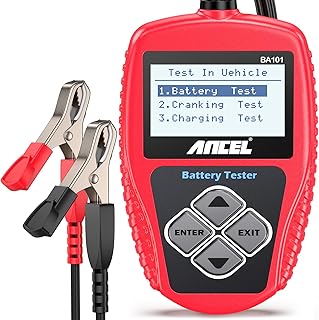 Best budget handheld · ANCEL BA101 — Check price on Amazon →
 Best overall · TOPDON BT300P — Check price on Amazon →
What an "alternator tester" actually tests
Almost every consumer handheld sold as an alternator tester runs the same three-part sequence:
- Battery test. It injects a small load or applies conductance (AC impedance) measurement and estimates state of health against the CCA rating you enter.
- Cranking test. It watches how far voltage dips during start and how long the dip lasts.
- Charging test. It reads voltage at the posts with the engine running, at idle and then with a load (headlights, blower) applied, and sometimes measures AC ripple from failing diodes.
That's genuinely useful. A tester that catches diode ripple above roughly 0.5V AC, or a charging voltage stuck at 12.6V, has saved you a tow.
Where it falls short
Smart alternators. Most vehicles built in the last decade or so use variable-voltage charging controlled by the ECM and a battery sensor on the negative terminal. The computer deliberately drops charging to ~12.3–12.8V during cruise to reduce engine load and improve fuel economy, then spikes to 14.5V+ during deceleration to recover energy. A handheld tester clipped on at idle sees that low voltage and may report "Charging System Low" on a perfectly healthy car. Equally, it can report "Good" on a car whose regulation only fails under specific load conditions.
Start-stop and AGM/EFB batteries. Start-stop vehicles typically use AGM or EFB batteries with different voltage and conductance characteristics. If your tester doesn't let you select the battery chemistry, its state-of-health estimate is working off the wrong model. Some cars also require a battery registration/reset after replacement — no tester tells you that, and skipping it makes a new battery behave like a tired one.
Intermittent faults. A 30-second bench test can't catch a regulator that drops out over a pothole or a worn brush that fails when hot. That's a job for logging, not snapshotting.
Parasitic drain. This is the big one. A tester that evaluates the battery and alternator says nothing about the 300mA a stuck body control module pulls all night. Drain is a current measurement over time, which is a completely different tool.
Handheld analyzer vs OBD logger vs clamp meter
| Tool type | Best at | Blind spots | Typical skill level |
|---|---|---|---|
| Handheld battery/charging analyzer (BT300P, BA101, KW208) | Battery state of health, CCA, cranking dip, ripple, static charging voltage | Smart-alternator variability, intermittent faults, parasitic drain | Beginner |
| Bluetooth OBD voltage logger (OBDLink MX+) | Charging voltage across real drive cycles, module-reported battery data, stored charging codes | No CCA/load test, no ripple measurement, reads control-module voltage not post voltage | Beginner–intermediate |
| DC clamp meter (UT210E) | Parasitic drain, alternator output current, starter draw | Nothing about battery health or regulator strategy | Intermediate |
| Shop-grade conductance tester (dealer/parts store) | Repeatable AGM/EFB health scoring with printed report | Cost, still a snapshot | Pro |
The honest answer for most home mechanics chasing a repeat dead battery: you need two of these, not one. A handheld for battery health and ripple, plus either an OBD logger or a clamp meter depending on whether you suspect charging or drain.
The picks
TOPDON BT300P — best overall
Prices last checked November 11, 2026. Amazon prices change frequently, so treat these as a guide and check the live price before you buy.
TOPDON BT300P
Bluetooth battery/charging analyzer with ripple and cranking tests plus app-based printable reports.
The BT300P is the handheld worth buying if you only buy one. It covers 12V battery testing across a wide CCA range, cranking analysis, charging-system voltage with and without load, and — importantly — AC ripple, which is the test that actually catches a failing rectifier diode pack before it cooks a battery. Bluetooth pairing with TOPDON's app means you can save and export a dated report for each test, which matters if you're tracking a battery's decline over months or arguing a warranty claim. Battery-type selection covers flooded, AGM, EFB and gel.
What it gives up: it's still a snapshot tool. It won't follow a smart alternator through a drive cycle, and it won't find parasitic drain. Interpreting its charging verdict on a start-stop car still requires you to understand variable-voltage charging.
ANCEL BA101 — best budget handheld
ANCEL BA101
Simple clamp-on tester covering battery health, cranking and charging voltage with clear pass/fail output.
If you want the three-test sequence — battery, cranking, charging — without an app, a subscription or a learning curve, the BA101 is the sensible floor. Clip it on, enter the CCA rating from the battery label, and it gives a clear numeric result plus pass/marginal/fail. Owner feedback is consistently positive on readability and on how fast it gets to an answer, and it needs no internal battery since it powers from the vehicle.
What it gives up: no ripple test on the basic unit, no data logging, no printable reports, and a simpler battery-type model than the BT300P. On a start-stop AGM vehicle, treat its state-of-health number as a directional indicator rather than gospel. For a once-a-season driveway check, that's fine.
KONNWEI KW208 — best for quick shop-style checks
KONNWEI KW208
100-2000 CCA tester with dedicated cranking and charging tests and a readable backlit screen.
The KW208 is the tester you reach for when you're checking several vehicles, or when someone's handing you a car and asking "is it the battery or the alternator?" It handles 100–2000 CCA, covers multiple rating standards (CCA, DIN, EN, IEC, JIS), and runs cranking and charging tests as separate selectable functions rather than one fixed sequence — handy when you only care about one answer. The backlit display reads well in a dim garage or under a hood at night.
What it gives up: no Bluetooth, no app history, and like all conductance testers it's sensitive to clamp contact quality. Clean the posts and clamp to lead, not to a corroded terminal clamp, or you'll chase phantom failures.
OBDLink MX+ — best OBD voltage logger
OBDLink MX+
Fast, secure Bluetooth OBD adapter that logs charging voltage live while you drive, not just at idle.
This is the tool that fixes the smart-alternator blind spot. The MX+ plugs into the OBD-II port, pairs over Bluetooth to a phone or laptop, and — with apps like OBDLink's own, Car Scanner or Torque — logs system voltage continuously while you drive. Instead of one idle reading, you get a graph: what the alternator does cold, at cruise, under deceleration, with the blower and heated seats on. That's the only way to confirm whether a 12.4V cruise reading is deliberate energy management or a failing regulator. It also reads manufacturer-specific charging and battery-sensor data on many vehicles, and it's one of the few adapters with a solid reputation for not disturbing vehicle networks.
What it gives up: it reports voltage as the control module sees it, which can differ from post voltage by a few tenths across bad grounds. No CCA test, no ripple, no load test.
UNI-T UT210E — best for parasitic drain
UNI-T UT210E
Clamp meter with true DC amps and a zero function — finds drain without breaking the battery circuit.
Parasitic drain is a current problem, and the UT210E is the cheapest reliable way to measure it. It's a clamp meter with true DC current capability and a zero/REL button, so you clamp it around the negative battery cable — circuit untouched, nothing to disconnect, no fuse to blow, and no risk of waking modules by breaking the connection. Let the car sleep for 30–60 minutes, then read. Most modern vehicles settle under roughly 50mA; sustained draw well above that points at a module that isn't going to sleep. You can also clamp the alternator output lead to see actual charging current.
What it gives up: low-current resolution is adequate but not laboratory-grade, so very small drains are harder to pin down than with a proper multimeter in series. It tells you nothing about battery health or regulator behaviour.
How to choose
Does your car have a smart alternator?
Check for a battery monitoring sensor — a small module bolted to the negative battery terminal with a wire running off it. If it's there, your vehicle varies charging voltage on purpose, and a handheld tester's charging verdict needs interpreting rather than obeying. On those cars, prioritise a logger like the OBDLink MX+ alongside whatever handheld you buy.
Battery chemistry support
Start-stop vehicles run AGM or EFB batteries. Buy a tester that lets you explicitly select the type — the BT300P and KW208 both do. Testing an AGM as a flooded battery produces an optimistic or pessimistic score depending on the algorithm, and neither is useful.
Snapshot or log?
If the symptom is "car is slow to crank every morning," a snapshot tester answers it. If the symptom is "battery dies randomly every few weeks," you need logging or drain measurement. Buy for the symptom.
Ripple testing
AC ripple above roughly 0.5V usually indicates one or more failed rectifier diodes. It's a cheap test to have and an expensive fault to miss, because ripple cooks batteries and confuses modules. Not every budget handheld includes it; verify before buying.
Clamp quality and lead length
Conductance testers are only as good as their contact. Thin clamps and short leads are the most common source of inconsistent readings on side-post and recessed-terminal batteries. If your battery lives in the trunk or under a seat — common on German cars and many start-stop models — check lead length and whether your vehicle provides remote jump terminals under the hood.
A quick diagnostic order of operations
- Charge and rest the battery first. Testing a deeply discharged battery gives a false "replace" result on a recoverable unit. Rest 4+ hours off charge before a conductance test.
- Clean and torque terminals. Half of all "alternator problems" are resistance at a connection.
- Run the handheld: battery health, cranking dip, charging voltage, ripple.
- If charging looks odd and the car has a smart alternator, log a 20-minute drive with the OBD adapter before condemning anything.
- If the battery dies while parked, stop testing the alternator and go find the drain with the clamp meter.
FAQ
Can a tester tell me whether the alternator or the battery is bad? Often, yes — a healthy battery plus low charging voltage under load points at the alternator, and a failed conductance score with normal charging points at the battery. But a weak battery can drag charging readings down and an over-charging alternator can kill a good battery, so the two faults disguise each other. Always test the battery after a proper charge.
What charging voltage should I see? On a conventional alternator, roughly 13.5–14.7V at idle with the engine warm. On a smart-alternator vehicle, anything from about 12.3V to 15V depending on what the ECM has decided, which is why a single reading proves little there.
Will a tester tell me if I need to register a new battery? No. Battery registration/reset is a manufacturer-specific procedure handled by a bidirectional scan tool or OEM software. Check whether your vehicle requires it before fitting a replacement — many European and start-stop models do.
Is a Bluetooth tester better than a plain handheld? Only if you'll use the data. The value is in saved, dated reports and in being able to show a trend. If you test one car twice a year, a plain handheld is fine.
How long should I wait before measuring parasitic drain? Give modules 30–60 minutes to go to sleep after the doors are closed and locked, longer on some vehicles. Measuring immediately after shutdown will show a high reading that's completely normal.
Get the best car care deals in your inbox
Join the GarageProof newsletter for hand-picked car care deals and new buying guides. No spam, unsubscribe anytime.
Related reads
ABS SRS Code Reader 2026: Check Coverage Before You Buy
An ABS SRS code reader is only as good as its vehicle list. Here are the mid-tier scan tools worth buying in 2026 — and how to verify coverage for your car first.
Bluetooth Car Battery Monitors 2026: Shunt or Terminal Clamp?
Compare Bluetooth car battery monitors for 2026: terminal clamps vs shunts, AGM and lithium profiles, parasitic drain logging, and terminal fitment checks.
Prime Big Deal Days OBD2 Scanners: Which Tier Is Worth It
Prime Big Deal Days runs October 6–7, 2026. Here's how to judge prime day OBD2 scanner deals by capability tier — code reader, live data, or bidirectional.